

The Assessment Toolkit
The Assessment Toolkit
Couldn't load pickup availability
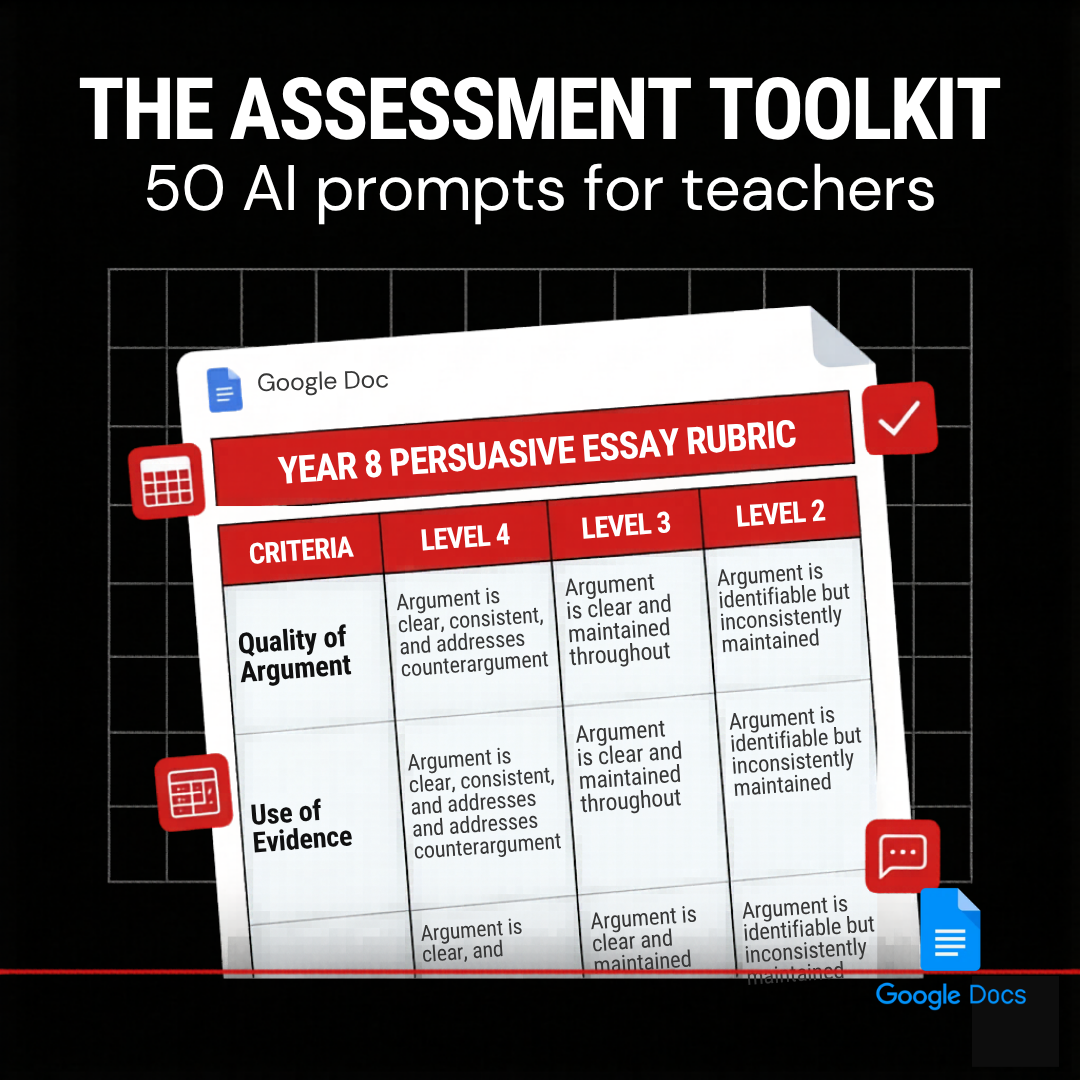
The Assessment Toolkit
Great assessment should not take all weekend to design.
The Assessment Toolkit gives you 50 expert-crafted AI prompts for designing tasks, writing rubrics, giving feedback that students actually act on, differentiating for every learner, and building student ownership of their own progress.
Better assessments. Half the time.
- 50 prompts across 5 categories, covering the full assessment cycle
- Built on real assessment theory and classroom-tested practice
- Works with ChatGPT, Claude, Gemini, or any AI tool you already use
- Delivered as a Google Doc, yours to keep forever
- New prompts added regularly, at no extra cost
- No subscription. No login. No more rubrics written at midnight.
You spent four hours designing an assessment task.
Then two hours writing the rubric.
Then another hour wondering if the rubric actually matches the task.
And you still have thirty pieces of work to mark.
Assessment is the part of teaching that never ends, and the part that gets the least support. Until now.
What It Is
The Assessment Toolkit is a 50-prompt library covering the full assessment cycle: designing meaningful tasks, writing criteria that actually communicate quality, giving feedback that students act on, modifying assessments for every learner, and building students into active assessors of their own work.
Every prompt is grounded in real assessment principles. Not generic. Not theoretical. Usable in your classroom this week.
What's Inside
50 prompts across 5 categories:
See It In Action
THE PROMPT (this is what you get inside the product):
HERE IS HOW ONE TEACHER USED IT:
WHAT CAME BACK:
Level 4: The central argument is clear, consistent, and addresses complexity or counterargument. Claims are purposeful and move the reader toward a specific position.
Level 3: The central argument is clear and maintained throughout. Claims are relevant and support the overall position.
Level 2: An argument is identifiable but inconsistently maintained. Some claims are relevant; others drift from the central position.
Level 1: A position is stated but not developed into a sustained argument. Claims are general or unrelated to a central idea.
DIMENSION: Use of Evidence
Level 4: Evidence is specific, well-chosen, and integrated smoothly. The writer explains how each piece of evidence supports the argument.
Level 3: Evidence is relevant and present. The connection between evidence and argument is stated if not always fully explained.
Level 2: Evidence is included but may be general, repeated, or loosely connected to the argument.
Level 1: Evidence is absent, irrelevant, or does not distinguish between opinion and fact.
[Language and Structure dimensions continue in the same format]
A rubric that took four hours to write manually. Done in two minutes.
Who This Is For
• The one who gives feedback but suspects students do not read it.
• The teacher trying to genuinely differentiate without ten extra hours per assessment.
• The Head of Learning who needs consistent, quality assessment design across a whole team.
If you assess students, this makes your assessments better and your weekends shorter.
How It Works
Step 1: Open your Google Doc copy
Step 2: Choose the prompt that matches your assessment need
Step 3: Fill in the [brackets] with your task, subject, year level, and context
Step 4: Paste into ChatGPT, Claude, Gemini, or any AI tool
Step 5: Review, refine, and use it
The AI gives you a professional, framework-backed starting point. Your expertise makes it excellent.
Delivery and Living Resource
Delivered instantly as a Google Doc link.
Click to open, go to File > Make a Copy, and it is saved to your Google Drive permanently.
This is a living resource. We add new prompts regularly as teaching evolves, and your copy gets every update automatically, at no extra cost. You are not buying a static PDF. You are buying a resource that keeps getting better.
Guarantee
This is a digital product and you receive full access the moment you purchase. For that reason, we do not offer refunds. If you have any questions before buying, we are happy to help. Reach out at bigspaceai.com and a real person will get back to you.
Design better assessments.
Give feedback students actually act on.
Get your weekends back.
FAQ
Does this work for primary and secondary?
Yes. Every prompt includes a [year level] bracket. Fill in your year level and the output is calibrated accordingly. The toolkit is used by teachers from Kindergarten through Year 12.
What about curriculum alignment?
Prompt 17 in the Rubrics category is specifically designed to align criteria to your local curriculum standards. Paste your standards in, and the AI writes descriptors that reflect the intent without copying the language verbatim.
What do I actually receive?
A link to a Google Doc. Click it, go to File > Make a Copy, and a permanent copy is saved to your Google Drive. Works on any device.
Will I get new prompts after I buy?
Yes. This is a living resource. New prompts are added regularly and your copy updates automatically at no extra cost.